
Super-resolution mmWave radar
My work on radar super-resolution studies how to make better use of measured FMCW signals under limited bandwidth and aperture. Two first-author IEEE Transactions on Consumer Electronics papers connect coherent signal extension with improved range and angle estimation.
Matrix pencil-based coherent extension
The method estimates signal components and reconstructs the gaps between consecutive chirps. Coherent combination produces an extended signal while retaining phase information. The work was evaluated with simulations and measured radar signals.
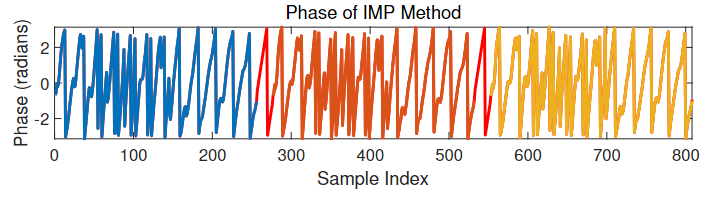
Z. Wu, Y. Li, T. Hu, C. Li, and Z. Luo. “Resolution Enhancement for mmWave Radar With Matrix Pencil-Based Coherent Extension.” IEEE Transactions on Consumer Electronics, 71(1): 2350–2352, 2025. DOI
Super-resolution range–angle estimation
The second paper develops a modified diagonal-loading strategy for the iterative adaptive approach (IAA), then combines range estimation and coherent extension to form a super-resolution range–angle map.
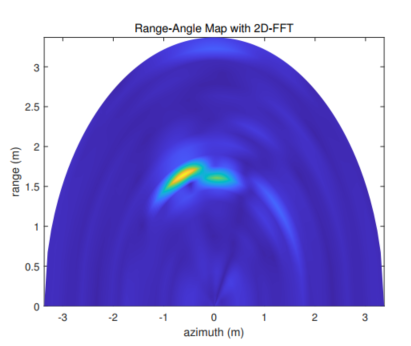
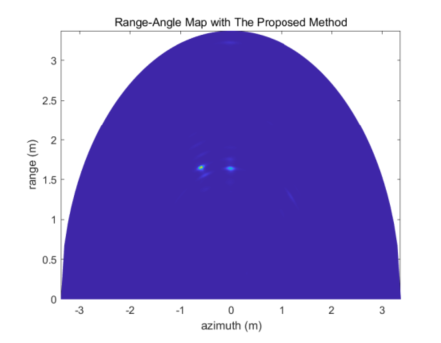
The figures are reproduced from the research presentation. For assumptions, evaluation conditions and method limitations, see the papers.
Z. Wu, X. Ma, F. Chang, C. Li, Z. Luo, and M.-F. Leung. “Enhanced Sensing for Automotive mmWave Radar: Super-Resolution Range and Angle Estimation With Coherent Extension and Advanced IAA.” IEEE Transactions on Consumer Electronics, 71(2): 4797–4806, 2025. DOI
From estimation to experiments
The mobile-robot platform provides the experimental setting for subsequent sensing and point-cloud work. The multimodal sensing platform supports repeatable data collection.